Wakefield Artist, Missionary and Blue Plaque Recipient
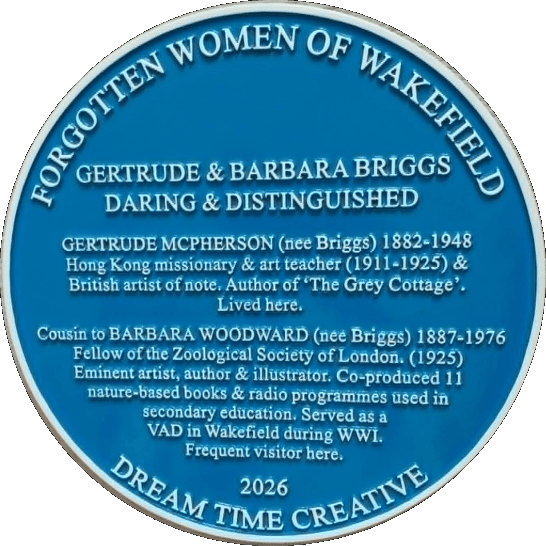
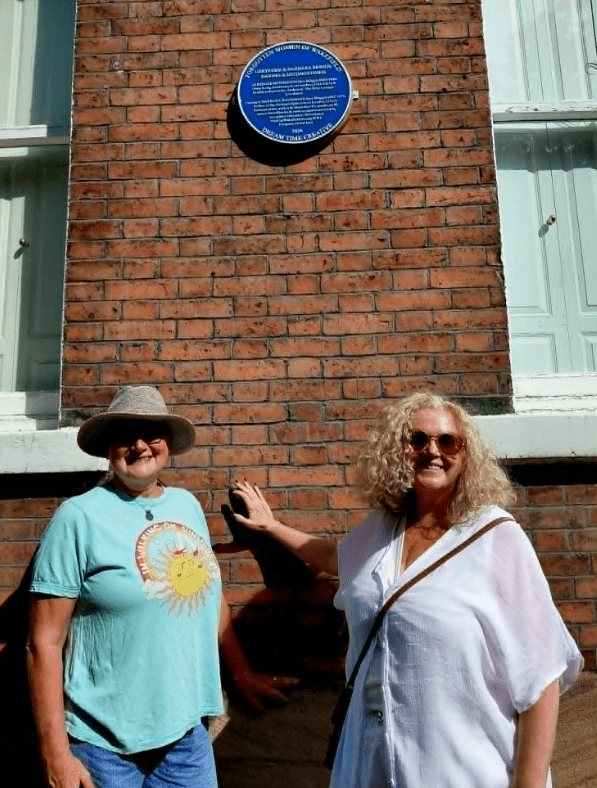
Gertrude McPherson née Briggs (1882–1948) was a Wakefield-born artist, teacher, missionary, author and creative force whose life connected St John’s, Wakefield with Hong Kong, Cheung Chau, Canada and Tunbridge Wells. In August 2026, a Forgotten Women of Wakefield blue plaque at 9 South Parade, her family home, commemorated Gertrude and her cousin Barbara Briggs.
Article written by Sarah Cobham based on the research of Sarah Cobham, Helga Fox and Lorraine Simpson. With special thanks to Gordon Briggs for access to family archives.
The Briggs Family of Wakefield: Engineering Heritage and Philanthropy
Gertrude was the granddaughter of Isaac Briggs, a pioneering engineer engaged in railway and canal construction across England. His friendships included Stephenson and Brunel. Gertrude and her cousin Barbara were part of “a highly respectable and opulent family, of St. John’s, Wakefield.”
Their grandmother’s family, the Shaws, were deeply involved in philanthropy and medical advancement in Wakefield, which opened up further opportunities for the family.
Women of the Briggs Family: Artists, Missionaries and Philosophers
The young women grew up in a time of extreme societal change. They contributed to that change and to the wider society by becoming scientific artists, members of influential literary sets, missionaries, writers, Voluntary Aid Detachment nurses, teachers, and philosophers.
The youngest of the three cousins, Gertrude Briggs, was born in 1882. She was the 9th of ten children of John Shaw Briggs Esq, a worsted manufacturer and merchant, and Emily Midwood of Hollingworth, a Sunday School teacher at the Independent Chapel there.
Wakefield Girls’ High School and the Influence of Gertrude McCroben
Living at 5 St John’s Square, Gertrude attended Wakefield Girls’ High School. Under the formidable headmistress Gertrude McCroben, she did well.

As a child, she was,
“Well read and interested in many things outside the range of her own special work, (which was) drawing and literature.”
wrote Gertrude McCroben in March of 1904 when writing Gertrude Briggs a reference for a teaching position. (From a personal file held with the London Missionary Society, Oriental Studies, UCL London).
No doubt influenced by women like Florence & Gwendoline Beaumont, Millicent Fawcett, Edith Grace Mackie and Lady Catherine Milnes Gaskell. She attended events with them to raise funds for good causes. Gertrude’s desire to forge her own path was clear from early on.
Art Education at Wakefield Technical and Art School
As an extremely talented artist, Gertrude also attended the Wakefield Technical and Art School. There, in 1900, she gained a 2nd class award for her painting from a Still Life and Design competition. And a 1st class award for freehand drawing. The following year, 1901, Gertrude gained 1st class in perspective and 2nd class in Geometrical Drawing and Light and Shade work.
As a result, Gertrude gained the Art Free Studentship from the Girls’ High School. This enabled her to attend the Liverpool University School of Art, where she gained a pass in the Oxford Senior. After becoming a member of the Royal Drawing Society, she gained her teacher’s certificate in art. It was her love of drawing combined with a desire to earn enough money to support herself that led to her first teaching position.
Teaching Art and Voluntary Mission Work in Suffolk and Whitby
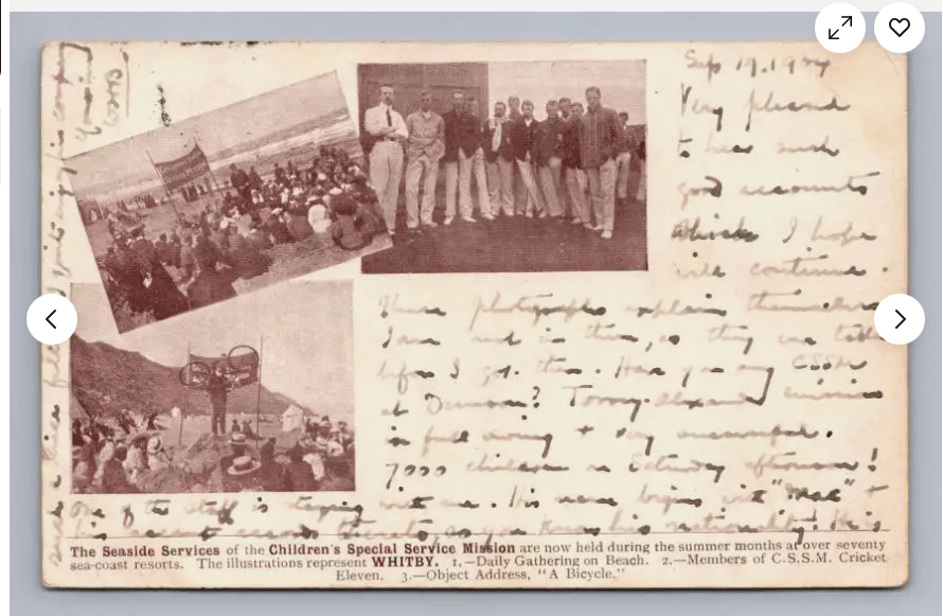
In 1904, Gertrude took a position as a drawing mistress at Langton House, Bury St Edmunds, Suffolk. She left after just one year to spend the summer of 1904 in Whitby at the Children’s Special Service Mission. But she left a lasting impression:
“I cannot speak too highly of her powers and her influence. Her high culture naturally tells in every subject she teaches.”
— M Ellen Steel L.L.A.:A.C.P (headmistress)
As a Missioner and one of a team of volunteers who organised highly visible activities on the beach for children and their families, Gertrude represented an evangelical movement that was less formal and therefore more attractive to people seeking to explore their spirituality more expressively.
Family Upheaval and the Call to Mission
The death of her father, in December of 1904, was a catalyst for change for Gertrude. By early February 1905, she had written to the London Missionary School offering herself for service in the foreign field.
Her aunt, Mary Briggs of Sandal Cliff, wrote a letter to the Rev. W. Thompson, the Foreign Secretary of the Society, to let him know that she was
“so very glad that one of (my) nieces has offered herself for foreign missions… and that Gertrude has the making of a strong character.”
Was it the call of God or the call of adventure? Gertrude had a small inheritance that gave her the means to escape life as an art teacher.
From Wakefield to Missionary Training in Edinburgh
By September 1905, Gertrude was in Edinburgh, training to be a missionary for the United Foreign Mission Free Church.
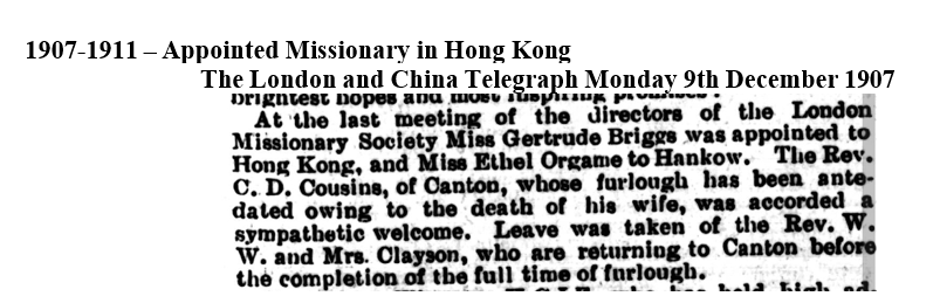
In 1907, the mission appointed Gertrude to a role in Hong Kong. It was here, in her capacity as an art teacher, something she enjoyed alongside her commitments to the mission, that she met a young man called John Livingston McPherson. He held the important role of General Secretary of the YMCA.
The pair married in Hong Kong in 1911, where they began building their lives together. They suffered the tragedy of losing their firstborn son, Angus, but later welcomed three daughters: Elizabeth (1914–2011), Katherine (1915–2002), and Marjorie (1918–2007).
Colonial Life in Hong Kong: Cheung Chau Island and Architecture
The family lived a life of colonialism at No. 6 The Peak. They played golf and tennis in areas that excluded Chinese people. As their daughters grew older, Gertrude did not wish to separate them from the family by sending them to boarding schools in England. Educating them privately was becoming increasingly difficult, and with some concern for their safety in the centre of Hong Kong, the family moved to the island of Cheung Chau. This preserved the southern area for Europeans, so the children could attend a European-only school.
The McPhersons had amahs to look after the home and care for the children. This allowed more time for Mrs McPherson to paint and to return to teaching once again. The girls grew up speaking fluent Cantonese, and people in Canada called them “the Chinese girls” when they returned there on furlough.
Gertrude designed the extension to the house, demonstrating her architectural skill and design eye.
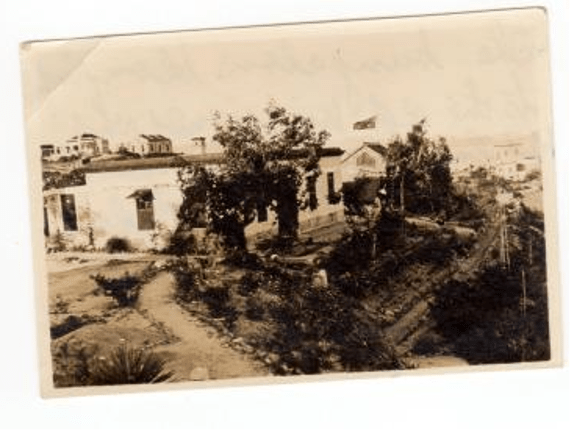
With thanks to Sean, Gertrude McPherson’s nephew, for this photograph of the bungalow on Cheung Chau Island, which has her handwriting on the back that reads: “The bungalow belonging to the old missionary who has lived here for five years and planted all the trees and plants around the house. He sort of superintends the island.”
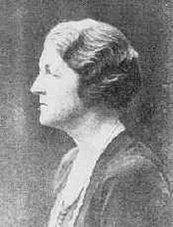
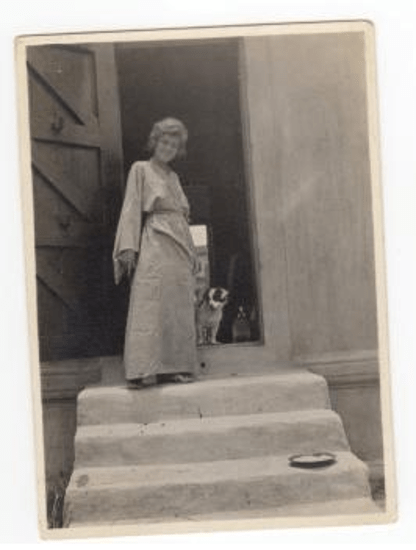
With thanks to Sean, Gertrude McPherson’s nephew, for this photograph of her, which is confirmed by handwritten notes by her on the back.
Art Exhibitions in London and Recovery from Stroke
Like many missionaries, the McPhersons travelled extensively. They spent time in Canada and London between 1923 and 1925. With the political situation between the Cantonese and the Yunnanese deteriorating, it was decided that Gertrude and her children would remain. From this point, Gertrude dedicated herself to her art. She exhibited at Chester Gallery in London in 1926, where critics described her pen-line and grey-wash drawings as “showing real imagination.”
In 1928, Gertrude had a stroke, which temporarily brought her husband home from Hong Kong.
Using her artwork to recover, further exhibitions of her artwork were held in 1930. Three paintings were particularly noted as being of “A quaint style”. These were “The Edge,” “Dawn in the Forest”, and “In Suburbs”. They are described as having “really wonderful compositions using clever satire.”
Grey Cottage: Publication and Social Commentary on Colonialism
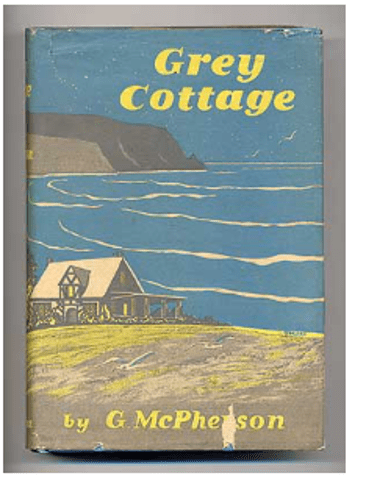
In 1933, Gertrude published a book called Grey Cottage in the USA and “A Few Things are Needful” in England. Grey Cottage signifies the escape from life to beauty. It is the home of artist Michael Donnelly, who dares not let life touch him. His quest for a new philosophy and reality is symbolic of Gertrude’s own life experiences in Hong Kong, and is a social commentary about colonialism.
Tunbridge Wells and the McPherson Stadium Legacy
By 1939, Gertrude and John were living in Tunbridge Wells, next door to the artist Harold Hope Read, who lived an avant-garde lifestyle with his live-in housekeeper, life model and mistress. He was known as “the Bohemian of Tunbridge Wells,” whose work is now acknowledged as the precursor of Edward Ardizzone’s.
On the 4th of May 1929, the Hong Kong Government founded the Playing Fields Committee to provide social welfare services to local children. John was a founding member, but Gertrude played an integral role in the delivery and development.
The Duchess of Kent laid the foundation stone for the McPherson Stadium, adjacent to the McPherson Playground, in 1952. This indoor stadium continues to play an important role in the development of youth recreation and is named after both John and Gertrude for their missionary work between 1905 and 1935.
Gertrude remained in Tunbridge Wells until she died unexpectedly at the age of 65 in 1948.
Forgotten Women of Wakefield Blue Plaque
Gertrude Briggs, along with her cousin Barbara, was recognised with a Dream Time Creative Forgotten Women of Wakefield blue plaque in August 2026. It is situated on 9 South Parade, her family home.