Phyllis Lett was one of the famed Lett family and sister to renowned educator Eva Lett, another of our Forgotten Women.
From her early performances in Wakefield to the concert halls of Europe, America and Australia, Phyllis Lett became one of the most celebrated contraltos of her generation. She performed with leading orchestras, worked with Edward Elgar and made recordings of her remarkable voice.
Yet despite her international success, Phyllis’s achievements are little remembered today.
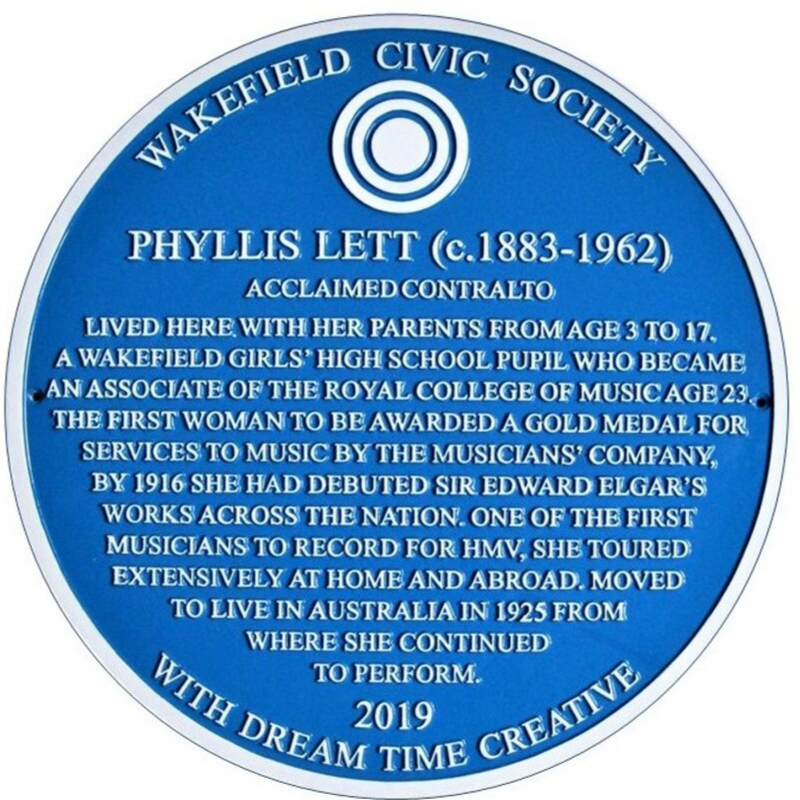
Phyllis Lett’s Early Life in Wakefield

Born in 1883, Phyllis lived in Wakefield until she was 17, and attended Wakefield Girls’ High School during the headship of Gertrude McRoben.
She made an early singing appearance at Wakefield Corn Exchange around 1899, during the Boer War. Although her career soon took her far beyond Yorkshire, she returned regularly to perform in Wakefield as part of her concert tours and for special occasions.
One such occasion was the unveiling of Queen Victoria’s statue in the Bull Ring. Wakefield, in 1905.
An International Singing Career
Phyllis’s career developed rapidly. In 1903, she made her official singing debut at the Royal Albert Hall during the Royal College of Music concert season. Within three years, she was performing as a contralto soloist at major musical festivals throughout Britain.
She appeared alongside leading singers, including Dame Clara Butt, and became a regular performer at the Proms.
The composer Edward Elgar particularly admired her voice. He sought her out to perform his The Dream of Gerontius from 1907 onwards. When planning a tour of Sea Pictures, he wrote:
“If we could get Phyllis Lett…”
Phyllis went on to perform Sea Pictures in Hull in 1909.
Her achievements brought numerous honours. These included recognition from the Royal Choral Society and a gold medal from the Worshipful Company of Musicians in 1916. Phyllis was the only woman to receive that distinction in a hundred-year period. She also became the subject of a portrait commissioned by the National Portrait Gallery.
Concert tours took her across Europe, Russia, and the United States. Her voice was recorded by companies including His Master’s Voice.
Phyllis Lett and the Early Recording Industry
Phyllis was not afraid to defend her professional reputation. When the early recording company Pathé Frères continued distributing poor-quality recordings of her voice, she took legal action, arguing that the recordings were damaging her career.
She won her case, an unusual and significant example of a woman performer challenging the recording industry during its early years.
Marriage, Australia and Later Life
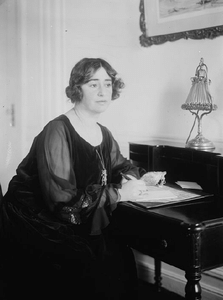
In 1924, Phyllis married her long-standing friend Charles Rupert de Burgh Ker, an Australian war veteran and sheep farmer. Before leaving Britain, she was in enormous demand. Her farewell performances included a concert at Crystal Palace attended by thousands. It was followed by a special wireless broadcast heard by more than ten million people across the country.
Phyllis settled in Australia, where she and her husband had a daughter, Patricia.
Although she continued performing, including a successful tour of New Zealand and Australia, rheumatoid arthritis increasingly affected her ability to sing professionally. Severe pain eventually forced her to cancel further engagements.
She continued to take an interest in music and was nominated as patron of the newly formed Richmond Philharmonic Society in 1935.
Phyllis returned to England only once more. By then, the woman who had once listed her occupation as ‘professional singer’ on passenger records was describing it as ‘home duties’. When she died on 1 June 1962, her passing received only a brief obituary in The Stage.
Her headstone carries the words:
“Her great courage and devotion knew no bounds.”
Hear Phyllis Lett Singing
Unlike many of the women whose stories we tell, Phyllis left us something extraordinary: recordings of her own voice. Listen to her rich contralto singing A Prayer to Our Lady by clicking on this button:
Phyllis Lett’s Wakefield Blue Plaque
Phyllis Lett is Blue Plaque Number 6 in our campaign for Blue Plaque Parity.
We unveiled her plaque in June 2019, following a ‘back by popular demand’ performance of Difficult Women? at the Mechanics’ Theatre.
Phyllis Lett Broadsheet
Discover more about Phyllis’s remarkable career, international performances, and later life in our free downloadable broadsheet.