Anne, Helen and Eliza Edmonstone were three sisters whose lives became closely connected with Wakefield naturalist Charles Waterton and his home at Walton Hall. Although the sisters played an important part in Waterton’s life and legacy, their own stories have received far less attention.
The Edmonstone sisters were women of colour whose family history connected Arawak ancestry in Guyana with wealth generated through Caribbean slavery. Their story adds an important and often overlooked dimension to the history of Charles Waterton and Walton Hall (also called Waterton Hall).

Anne Edmonstone and Charles Waterton
Anne Edmonstone married Charles Waterton when she was just 17 and he was 47. Her family wealth helped to support the life and work that allowed Waterton to pursue his interests in natural history.
Anne died young, but her sisters Helen and Eliza had became part of life at Walton Hall. After his death, Helen and Eliza Edmonstone helped to preserve Charles Waterton’s legacy. This included his extensive collection of letters.
For many years, accounts of Waterton’s life concentrated overwhelmingly on the celebrated naturalist himself. Researching Anne, Helen, and Eliza allows us to explore a less familiar part of that history and restore the sisters to a story in which they also played an important role.
A Wakefield Blue Plaque for the Edmonstone Sisters
We unveiled a blue plaque commemorating Anne, Helen, and Eliza Edmonstone as part of our International Women’s Day events on 12 March 2023 at Westgate Chapel in Wakefield.
Dr Shardia B. Palmer, Assistant Professor in Sociology at the University of Nottingham, unveiled the plaque.
The unveiling took place in a particularly successful year for the project. In 2023, the National Community Archives and Heritage Group named Dream Time Creative and the Forgotten Women of Wakefield project its Community Archive and Heritage Group of the Year.
KLTV filmed the blue plaque event, and you can watch their video below.
The Edmonstone Women: An Artistic Response by Zainab Jode
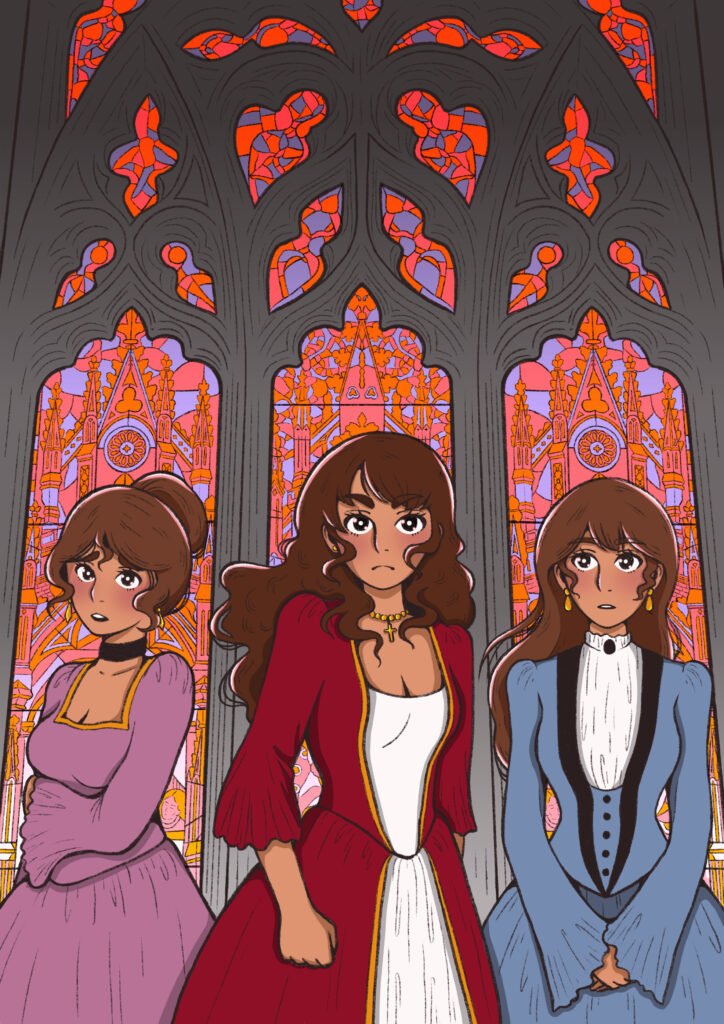
Local artist Zainab Jode responded to the stories of Anne, Helen, and Eliza through her manga-inspired artwork.
Local artist Zainab Jode responded to the stories of the Edmonstone women through her manga art style, contrasting the sisters’ rich heritage against a modern, beautiful art form.
As seen through Zainab’s eyes, the defiant story told by this image speaks of three sisters, Eliza, Anne and Helen, reclaiming their narrative.
The Edmonstone Sisters, Charles Waterton, and Slavery
Research into the Edmonstone sisters also revealed a less familiar, and more challenging, aspect of the history surrounding Charles Waterton.
Slavery in British Guiana contributed to the Edmonstone family’s wealth. Anne’s father, Charles Edmonstone, was a Scottish plantation owner and slave trader. Anne’s marriage to Charles Waterton connected him to a family whose fortune depended partly on slavery. He benefitted greatly from their patrimony.
This research adds another dimension to the story of a man widely celebrated in Wakefield and among naturalists for his pioneering work in conservation and natural history. It also raises important questions about the women whose family wealth supported his life and work, but whose own stories have received much less attention.
With funding from the National Lottery Heritage Fund, local filmmaker Jason Wakefield created three short films exploring these connections, the sisters’ experiences as women of colour, and the circumstances in which Anne, Helen and Eliza lived.
Catherine Clarke reads narratives based on research by Helga Fox, Sarah Cobham and the project’s creative research team.
*** Black History Month *** 2026
Thank you for watching and listening to Whitewash, an excerpt from my book, Murder, Slavery & Whitewash, recognising the lives of enslaved people that Charles Waterton denied ever existed.
SAY THEIR NAMES
Edited by Finn Boreham, Whitewash was featured in Tenterhooks – New Writing from the University of Leeds, and performed by me at an end-of-year celebration of the students’ work from across the English Department.
University of Leeds
The research upon which this writing is based came from a project called Petticoat Patrimony, by my arts company, Dream Time Creative & The Forgotten Women of Wakefield, which told the story of The Edmonstone Women, Eliza, Anne-Mary, and Eliza, women of mixed heritage from Demerara, whom Waterton also collected.
Thank you , Sarah Cobham
Press and Further Information
Throughout late 2022 into 2023, and in the countdown to International Women’s Day 2023, project lead Sarah Leah Cobham has published a weekly column for Yorkshire Bylines. In this, she serialises, contextualises and explains the sisters’ story. She explores how patriarchal accounts have written them out of the narrative. She also examines how historians have, often wilfully, overlooked Charles Waterton’s connections to slavery.
You can find the article series here: Sarah Cobham, Author at Yorkshire Bylines.
And at the link below you can see an entry into the official UCL database, The Centre for the Study of the Legacies of British Slavery, regarding Charles Waterton and his proven links to the enslavement and exploitation of indigenous peoples. To find his entry, please type into the search bar “Charles Waterton” and select his name from the results.
Summary of Individual | Legacies of British Slavery (ucl.ac.uk)
We credit all of our researchers — Helga Fox, Sarah Cobham, Catherine Clarke, Zainab Jode and Abibat Olulode — for their work uncovering and exploring Waterton’s links to slavery. Their research also examines how wealth derived from British slavery directly supported his contributions to natural history.